Man, life gets you sometimes, doesn’t it? Like, you’re just chugging along, thinking you got it all figured out, and then BAM! You hit a wall. Or maybe it’s not even a wall, just this hazy, murky mess where you can’t quite see where you’re going. That was me, a few years back. Just kinda drifting, you know? Not really unhappy, but not exactly fired up either. Just… floating.
I remember just feeling this low hum of restlessness, always wondering if there was something more, or if I was just missing a trick somewhere. I’d try to talk it out with folks, read self-help books, even tried journaling a bit. But nothing really stuck, nothing really made that inner compass needle twitch. It felt like I needed a different angle, something totally outside my usual way of thinking.
Stumbling onto the Old Book
Then, one day, I was just rummaging through a buddy’s bookshelf – he’s got all sorts of weird and wonderful stuff – and I spotted this old, thick book with a super simple cover. It was the I Ching. I’d heard bits about it, mostly like, “ancient Chinese oracle” or “book of changes.” Sounded kinda mystical and, honestly, a bit intimidating. But something about it just snagged my attention.
I borrowed it, figuring what the heck, couldn’t hurt, right? Took it home, put it on my nightstand, and it just sat there for a few days. I mean, where do you even start with a thing like that? It looked dense, full of metaphors and ancient wisdom I felt way too dumb to grasp. But that nagging feeling of needing a fresh perspective eventually pushed me.
My First Tries: A Bit Clumsy, A Bit Confused
So, one evening, I finally cracked it open. The first few pages were all about how to use it. Coins, yarrow stalks… I just went for the coins, seemed simpler. Found three old pennies lying on my desk. The instructions said to ask a question, really focus on it. So I did. I asked something vague like, “What should I be focusing on right now?”
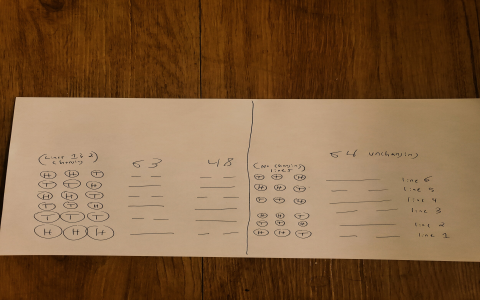
Then came the tossing. It told me to toss them six times. Each toss gives you a line. Two heads and a tail is one kind of line, three tails is another, and so on. It sounded like a weird game. I remember feeling a bit silly, honestly, just sitting there, flicking coins onto my desk like some kind of ancient gambler. I’d toss, note down the line, toss again. Six times. Pretty straightforward, physically.
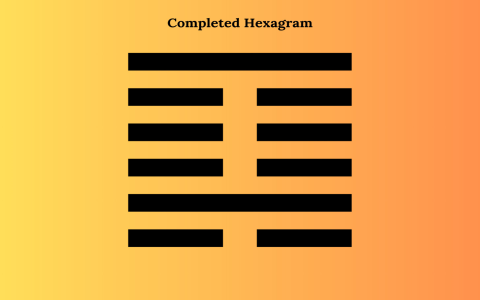
Once I had all six lines, top to bottom, I started drawing them out – solid or broken. That’s your first hexagram. Then, some lines were “changing lines” based on getting all heads or all tails. Those lines flipped to their opposite, giving you a second hexagram. So, you end up with two of these six-line symbols.
Wrestling with the Wisdom
Okay, so I had my two hexagrams. Now what? This was the really tricky part. I had to look them up in the book. The book would give you a name for the first hexagram – like “Obstruction” or “The Cauldron” – and then a big chunk of text explaining its general meaning. Then, it would explain each of the changing lines in the first hexagram, and finally, there’d be a shorter bit on the second hexagram.
My first few attempts? Total head-scratchers. The words were so poetic, so abstract. “The wise person cultivates their inner strength and waits for the opportune moment.” Or, “crossing the great water brings good fortune.” What did that even mean for me, sitting in my messy apartment, trying to figure out if I should take on more freelance work or finally tackle that home repair project?
I’d read it, reread it, scratch my head. I’d try to force it to mean something specific, something like a direct answer. But it never gave me that. It was frustrating. I almost gave up, honestly. But then, I dunno, something just told me to keep trying. Maybe it was the sheer novelty of it, or just how different it felt from everything else I’d tried.
When Things Started Clicking
What really changed was when I stopped looking for specific answers and started looking for a different perspective. I stopped asking “Should I do X?” and started asking “What’s the energy around X right now?” Or “What’s the underlying current of this situation?”
I’d just sit down with my coins, usually first thing in the morning with a cup of coffee. I’d really take a minute to think about what was on my mind, what felt heavy, what felt unclear. Then I’d phrase my question, often just in my head, sometimes out loud. Things like:
- “What wisdom do I need for today?”
- “How can I approach this tricky conversation effectively?”
- “What’s truly important in this decision I’m facing?”
Then, the coin tossing. One, two, three, four, five, six. Write it down. Look it up. And this time, instead of trying to shoehorn it into an answer, I’d just read the text, slowly, let the words wash over me. I’d try to find the feeling in it, the underlying message that spoke to my gut.
I remember one time I was really stressing about a big project at work, feeling totally overwhelmed. I tossed the coins, and the reading was all about “The Well.” It talked about how the well provides sustenance, but you have to draw from it yourself. It’s always there, but it requires effort to get what you need. And it also talked about making sure the well is clean, not stagnant.
That really hit me. It wasn’t telling me the project would be easy or that I’d get a raise. It was telling me to focus on the basics, the resources I had, and to keep my own “well” (my mind, my energy) clear. It wasn’t about the grand outcome but about the steady, consistent effort and self-care in the process. It gave me a framework to think about my approach, instead of just spiraling in panic.
My Daily Companion
It’s become a bit of a routine now, though not strictly daily. More like whenever I feel that familiar hum of uncertainty, or when I just need a moment to pause and reflect. It’s not about magic or predicting the future. It’s a tool, a really old, really wise tool, that helps me step outside my own head for a bit.
It makes me think about things differently. It gives me these ancient snapshots of human experience and tells me, “Hey, this isn’t new. People have felt this way for thousands of years. Here’s a way to look at it.” It’s like having this really old, really insightful grandparent just whispering some profound, sometimes cryptic, advice in your ear. And you know what? Most of the time, that’s exactly what I need. It grounds me, makes me reflect, and helps me keep moving, even when the path ahead looks a bit hazy.