
So, I was looking through some of my old readings for folks who were asking about their jobs and cash flow. You know, that whole grind of figuring out how to actually move up in the world. I pulled up a bunch of notes on the Page of Swords, ’cause that little guy shows up a lot when people are restless about their careers.
Starting from Zero with the Page of Swords
When I first started digging into how this card plays out in real life—not just in books—I realized it’s all about a spark, that initial burst of energy. Most of the people seeing this card aren’t stuck; they are planning to move, but they are just staring at the map. Or sometimes, they just opened their mouth and said something they shouldn’t have at the Monday meeting.
I tracked one case where a guy, let’s call him Alex, was constantly complaining about his stagnant role. He kept getting the Page of Swords. I told him straight up: “You’ve got the idea, but you haven’t actually done anything yet.” He was absorbing information, watching YouTube tutorials, reading industry news—all the mental prep. But the action? Zip.
- The Initial Move: We broke down his idea of starting a side hustle. It was all theory until then.
- Identifying the Flaw: The Page of Swords, in this context, was his tendency to over-analyze and be a little bit mouthy when critiques came his way. He talked a big game but hadn’t shipped anything.
- The Fix: We forced a small, tiny launch. Just a cheap website and one service offering. No perfection allowed.
That initial push was brutal for him because he wanted everything polished. But the Page of Swords is messy. It’s the moment before skill is refined, pure enthusiastic experimentation.
In the Workplace: Taming the Sharp Edges
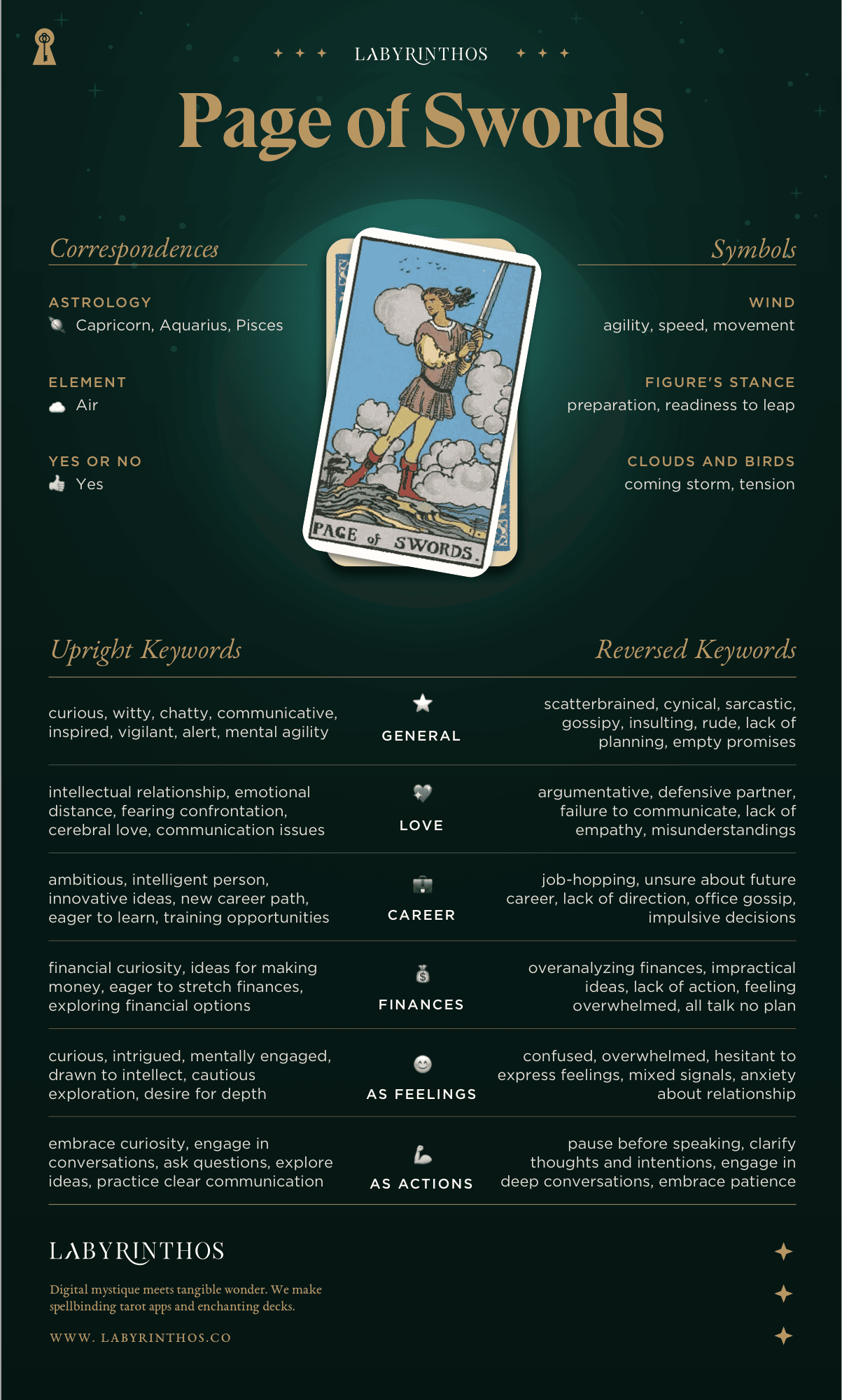
I noticed a common pattern when this card pops up related to office dynamics. It’s usually someone who’s super bright, sees the flaws in the system immediately, but presents their findings in a way that feels aggressive or overly critical to the higher-ups. They’re trying to prove their worth by being the smartest person in the room, but they end up just stabbing the air.
I had to coach one client, Sarah, who was getting passed over for promotions. Every performance review she’d get told she needed to work on her “communication style.” The cards screamed Page of Swords every time we asked about her office interactions.
What we did was stop focusing on the big career jump and started focusing on how she delivered her observations. It was a practice of restraint.
Instead of bursting into the manager’s office with a 10-point critique of the new project’s budget, we practiced phrasing it as a “potential optimization area” during a scheduled one-on-one. Still the sharp mind of the Swords, but with a bit of a velvet glove.
The Money Aspect: New Ventures and Risk
When this card shows up specifically about money, it’s rarely about a stable paycheck. It’s about an idea for a new revenue stream, or maybe a speculative investment that seems clever but needs more groundwork.
I documented a financial reading for a woman considering dropping a chunk of cash into crypto based on a “hot tip.” Page of Swords flashed bright. It wasn’t that the investment was bad, it was that her knowledge base was shallow and driven by pure excitement (the youthful energy of the Page) rather than informed strategy (the eventual Knight or King).
My advice, rooted in observing this pattern, was to invest time before investing money. She spent two months just reading whitepapers and market analysis instead of rushing in. When she eventually did invest, it was smaller, smarter, and less emotionally charged. The Page of Swords got her interested, but the hard work of research (the discipline) actually got her ahead.
My Takeaway on Getting Ahead
If you see the Page of Swords about your career, you’ve got the energy and the smarts, but you’re probably either just talking about it or acting without thinking through the political consequences. The way to ‘get ahead’ isn’t to ditch the energy, it’s to channel it with discipline.
I always tell clients: The Page of Swords hands you a sharp tool. Don’t use it to carve your name into your desk. Use it to cut away the clutter and find the path forward. It means taking that raw idea, refining the communication, and most importantly—moving from being the brilliant observer to the actual implementer.