
Man, let me tell you, when someone first mentioned the I Ching to me, I just kinda rolled my eyes. Sounded like some dusty old book full of riddles. But, I don’t know, a buddy kept bringing it up, saying it actually helped him sort out his head when things got messy. So, one day, fed up with my own mental noise, I finally said, “Alright, show me.”
I distinctly remember him showing me how to toss the coins. Three pennies, six times. Heads or tails, a broken line or a solid line. It felt kinda silly at first, like some parlor trick. He showed me the book, with all these weird symbols and what felt like super cryptic poems. I picked a random one, just to try, and it was Hexagram 50, “The Cauldron.” I looked at it, looked at the words, and honestly, felt nothing. Just a jumble. Didn’t make much sense. I figured, “Well, that was a bust.”
But then, something nudged me. Maybe it was just curiosity, or maybe I was desperate for any kind of insight. I decided to actually commit to it for a bit. Not every single day, but whenever I felt a bit lost or needed a kick in the pants. I grabbed my own three coins – lucky ones, of course – and started trying to get my daily guidance, especially watching for that Cauldron hexagram.
My process, it evolved. At first, I was just blindly tossing, then reading the main text for Hexagram 50. It talked about offerings, renewal, making things fresh and new. I’d read it, scratch my head, and usually just move on. Then, I realized the real juice was in the changing lines. Each toss that landed as a “changing line” suddenly gave it a whole new flavor. It added layers, like peeling an onion.
So, here’s how I got into it, step-by-step, especially when that Hexagram 50 kept showing its face when I needed it most:
- First off, I’d set my intention. Real simple. Not some big, grand meditation. Just a quick “What do I need to hear today?” or “How can I tackle this problem I’m facing?” Sometimes it was just, “What’s the vibe?”
- Then, the coin toss. Grab those three pennies, give ’em a good shake in my hands, let ’em fly onto the desk. I’d write down the result. Six tosses, bottom to top. It builds the hexagram.
- Look it up in my trusty old book. My buddy actually gave me his old, dog-eared copy. I’d find the main Hexagram, then check out the changing lines. More often than not, when I was feeling a bit adrift or uninspired, Hexagram 50, the Cauldron, would pop up.
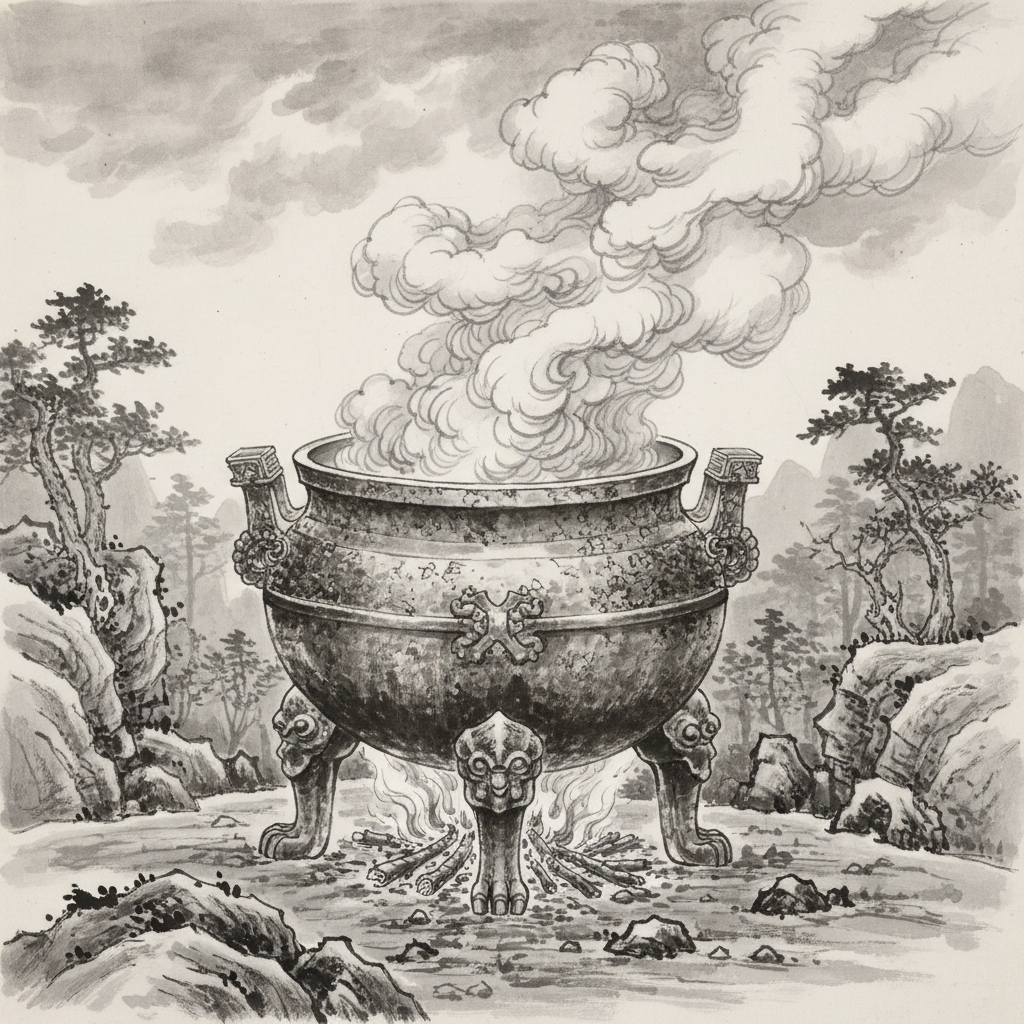
- Read the main judgment and the image. For the Cauldron, it always speaks to me about cooking up something new, about nourishment, about getting rid of the old and making space for the fresh. It’s about transformation, like something boiling away in a pot, becoming something better.
- Then, I’d dive into those changing lines. This is where it got personal. Each line in Hexagram 50, they’re like little mini-stories about how that transformation is happening.
- Sometimes it’s about turning the Cauldron over – meaning, maybe I need to get rid of something old and useless, empty it out to make room.
- Other times it’s about a full Cauldron with food, reminding me that I have what I need, or that I need to be ready to share what I’ve got.
- Once, I got a line about ears of the Cauldron being broken off. That hit me hard. It felt like a warning that I was letting my tools, or my plans, become useless because I wasn’t paying attention. It pushed me to fix things up, to get my act together.
- The top line often spoke about the Cauldron having jade handles – pure and precious. It felt like a pat on the back, or a reminder to act with integrity, to handle my “ingredients” with care.
- And this is the big one: reflection. I’d take a few minutes, sometimes just in my head, sometimes I’d jot it down in a notebook. “How does this apply to me today?” “What’s boiling in my life right now?” “Am I nurturing the right things?” “Do I need to clean out my Cauldron?”
There was this one time, I was totally stuck on a project at work. Just spinning my wheels, feeling like I was stirring mud. I tossed the coins, and boom, Hexagram 50, with a changing line saying something about the Cauldron being empty but still being used for cooking. It clicked. I wasn’t putting anything new in. I was just re-heating old ideas. I needed to go out, get fresh ingredients, talk to different people, listen to new perspectives. It literally made me step away from my desk, go out for a walk, and by the time I came back, I had a fresh take on the problem.
Another day, I was feeling spread thin, trying to do too many things for too many people. Again, Hexagram 50, but this time with a line about the Cauldron being overloaded, nearly spilling. It was a clear sign: I needed to lighten my load, prioritize what truly mattered, and not try to be everything to everyone. It wasn’t about selfishness, but about self-preservation, so I could actually nourish what was important.
You know, it’s not magic, it’s just… a different way to look at things. It pulls you out of your own head and gives you a framework. It makes you ask questions you might not have thought of. It’s like having an old, wise friend who speaks in poetic riddles, but those riddles somehow always hit home. That Cauldron, Hexagram 50, it became a regular prompt for me to check in, to make sure I’m cooking up good things in my life, and not just letting old stuff burn.
It’s raw, it’s personal, and it works for me. It’s definitely not some complicated academic exercise; it’s just getting down to business with yourself. Just a real simple way to get a little nudge when you’re fumbling for answers.