
Man, let me tell you, for a while there, I was just running in circles. You know that feeling when you’re pushing and pushing, but it feels like you’re just hitting a brick wall every single time? That was me. It wasn’t about a big company thing or some grand existential crisis; it was just this nagging feeling that no matter what I touched, it felt constrained. Like something was holding me back, but I couldn’t quite put my finger on it. I was working on this personal project, pouring hours into it, trying to get it off the ground, and it just wasn’t happening. Every turn, a new obstacle. Every step, a new delay. I started to get really down about it, questioning everything I was doing.
I remember one particularly frustrating evening. I had just spent another whole day trying to fix this one small bug, and it felt like the more I tweaked, the more things broke. I threw my hands up, walked away from the screen, and just stared out the window. My brain felt fried. I kept thinking, “What am I missing? Why is this so hard?” It wasn’t just this project; it felt like a pattern in my life, always bumping up against some invisible ceiling. I needed a fresh perspective, something way outside my usual tech-bro thinking.
I’d heard bits and pieces about the I Ching before, mostly from some old books I’d skimmed. Never really dug in, you know? Seemed a bit mystical, a bit too ‘woo-woo’ for my practical mind. But that night, desperate for any kind of insight, I remembered an old friend mentioning it. Said it was less about fortune-telling and more about gaining perspective on your current situation. Figured, what did I have to lose? I pulled out an old copy I had stashed away, dusted it off, and decided to give it a shot. I wasn’t looking for answers, just a different way to frame my problem.
I went through the whole coin-tossing ritual, pretty clumsy at first, trying to make sure I got it right. It felt weird, almost silly, but I stuck with it. After a few rounds, I mapped out the lines, bottom to top, and there it was. The hexagram I got was number 60. Now, I opened up the book, looking for the interpretation. The first few lines I read, honestly, they just confirmed my frustration. It talked about “Limitation,” “Regulation,” “Constraints.” My first thought was, “Great, even the ancient wisdom agrees. I’m just limited. This project is limited. My whole life is just full of limitations.” I felt a bit deflated, like it was telling me to just stop trying.
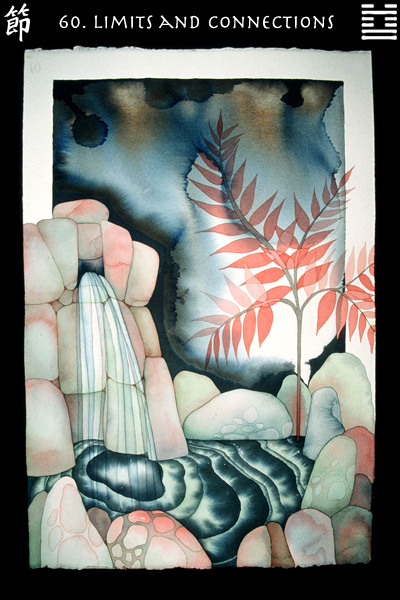
But I kept reading. That’s the thing about these old texts, they aren’t always straightforward. It said things like “Joyful acceptance of limitation,” and “Regulations are necessary for order and progress.” That’s when it started to click, really subtle at first. I was so focused on what I couldn’t do, on the obstacles, that I wasn’t seeing the value in those very boundaries. I was fighting against them, seeing them as roadblocks, instead of as guardrails. The book went on about how clear boundaries actually make things possible, how they provide structure. I realized I was trying to build this project without any real internal limits, just throwing everything at it, which was actually making it chaotic and impossible to finish.
My “aha!” moment really came when I thought about those lines: “Hidden strengths.” The insight wasn’t about my project being doomed, but that the very limitations I was fighting against were actually trying to tell me something important. They were defining the playing field. I started to look at my project again, not as a limitless endeavor, but within the scope of my current resources, my time, my skill set. I realized I had been trying to build a mansion with a toolkit meant for a shed. That’s where the constraint was – not external, but internal, in my own unrealistic expectations and lack of self-imposed structure.
Recognizing the Boundaries
- I started by really defining what was realistic for my project. I mean, truly. Not what I wished it could be, but what I could do given my actual daily time and current coding ability.
- Then, I broke it down, not into huge, daunting tasks, but tiny, manageable pieces. Each piece had its own clear boundary: “This feature will only do THIS ONE THING.” No mission creep.
- I also looked at my personal time. I was burning out. So I set a hard limit: “Two hours a day, and then I walk away.” That was a huge regulation I put on myself, and it felt so liberating.
Once I started implementing these self-imposed limitations, things completely shifted. It wasn’t about me being “limited” anymore; it was about me being “focused” and “disciplined.” Those boundaries I once saw as frustrating obstacles, I now saw as the very framework that allowed me to build something solid. Instead of getting overwhelmed by the sheer scale of my vision, I could celebrate finishing a small, well-defined piece. My energy came back. My frustrations lessened. The project started moving forward, not with a bang, but with steady, consistent progress.
What I learned from Hexagram 60 wasn’t to throw in the towel, but to deeply understand the actual playing field. It showed me that true strength often comes from recognizing and working within the given limits, rather than constantly fighting against them. Those perceived limitations were actually my biggest teachers, forcing me to get clear, to prioritize, and to build with intention. And honestly, it changed not just how I approached that project, but how I tackle almost everything now. It showed me my own hidden strength was in my capacity for self-discipline and intelligent restraint, something I totally missed when I was just blindly pushing.