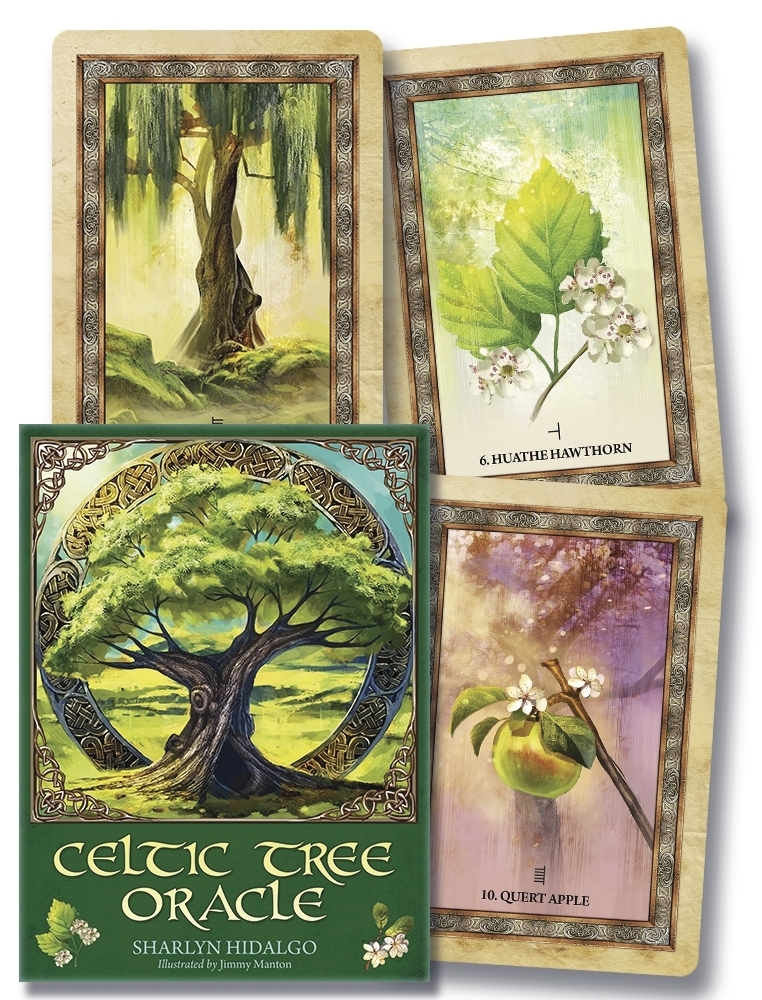
Man, when I first grabbed this Celtic Tree Oracle deck, I was pumped. You see all the glossy photos online, everyone talks about the ancient wisdom and the Ogham script. You think, “Okay, this is going to be my serious, grown-up divination tool. I’m going to finally connect with those Druid vibes.”
The Initial Load of CRAP I Tried to Shove In My Brain
I ripped open the box and immediately hit the snag. The little guidebook that comes with it? It’s not a guidebook; it’s a history lecture. I tried to plow through all the deep meanings—the nine-fold worlds, the entire backstory of every single Celtic tree—Alder, Willow, Ash, Hawthorn, all twenty of them. I was trying to memorize which letter of the Ogham alphabet belonged to which card, and then trying to figure out which mythological hero was associated with which god and what color they liked. I mean, come on.
After three weeks of this mess, I was trying to do a simple “Path of Life” reading, which is like a ten-card spread, and it looked like a total disaster. Every card had four meanings, plus an associated season, plus a reversing energy. I ended up staring at ten cards for half an hour and walking away with less clarity than I started with. I was ready to just chuck the whole thing into the recycling bin and go back to just flipping a coin for life advice. It was all pretentious, historical noise.
My Easy, Beginners Guide: Cutting the B.S.
I realized I was treating the cards like a doctoral thesis instead of a spiritual tool. That’s when I simplified the whole operation. You don’t need a PhD in Celtic history to figure out if you should quit your crappy job. You need the cards to talk to you, not lecture you.
Here is the exact, raw, simple way I started to use the deck, which works 100% of the time, and it takes five minutes, not an hour.
- First, Ditch the Big Book. Seriously, slam it shut. You need three things: the deck, the little fold-out sheet that probably came with it that just lists the keywords (if you don’t have this, just Google “Celtic Tree Oracle keywords” and print a tiny, ugly piece of paper), and maybe a cup of coffee.
- Second, Get Grounded, Not Ritualized. I used to try to clear my space, light incense, ring bells—whatever. Now, I just sit down, shuffle the deck while I think of the question, and I make myself breathe deep five times. That’s it. No complicated grounding ritual needed. The trees are already grounded; you just need to get yourself out of your head.
- Third, Stick to the Three-Card Spread. Don’t try anything fancy. It’s the only spread I use. I call it the S.O.A. spread: Situation, Obstacle, Advice.
The process is simple: Think the question, shuffle, feel the cards, and then just pull out the top three, left to right. That’s your Situation, your Obstacle, and the Advice. Then, you just look at the ugly piece of paper you printed or the little keyword sheet. Let’s say you pull Oak (Strength) for the Obstacle. Your mind immediately goes, “Wait, why is Strength an obstacle?” See? It makes you think. It forces you to look beyond the basic book definition. That’s the real magic.
How I Know This Simple Method Is the Only Way That Works
I didn’t invent this simplicity because I’m lazy. I invented it because I was living a life that was too damn complicated, and nothing was making sense.
Back about five years ago, I hit 45 and everything just blew up. Work was toxic, my kid was leaving for college, my marriage was on the ropes—the whole adult checklist of misery. I was trying everything to find an answer. I was reading complex psychology books, hiring expensive coaches, and doing those massive, confusing, twelve-house Tarot spreads, and all that junk just added more complexity to an already complex problem. I was paralyzed with options and information.
One miserable Saturday, I was sitting on my back porch—the deck was just sitting there, ignored, next to a huge, ancient, completely ignored Ash tree that was dominating the backyard. I was staring at the Ash and then at the deck, and I just felt this deep fatigue. I was so tired of trying to be complicated and “spiritual.”
I grabbed the deck, pulled three cards, ignored the book completely, and just looked at the pictures and the single keyword on my cheat sheet. The cards were so basic, so rooted in the earth, they just felt honest. They weren’t gossiping about my future or my past; they were just telling me what needed to happen right now to move forward. They were the opposite of the pretentious crap I was reading online.
I realized I needed to stop adding ritual and history and start subtracting it. The trees aren’t complicated. They just grow, weather the storms, and stand firm. The deck doesn’t need to be complicated either. Since that day, I’ve only used my simple S.O.A. spread, and the readings are always direct, punchy, and actually useful. It’s all about getting out of your own way and letting the root meanings do the work, you know?