
I swear, when I first grabbed that Sibyl deck, I thought reading the Ten of Pentacles was going to be the easiest thing ever. Every book, every stupid little pamphlet you find online, tells you the same predictable junk: family money, home security, generations of wealth, you’re set for life. I bought into that mess for months, absolutely months.
I’d sit down with folks, pull this card, and chirp out the textbook answer. “Oh, you’ll be financially stable!” “A great home is coming your way!” And you know what? It felt dead every single time. It was like I was selling them a used car with flat tires. The predictions were always too vague, too optimistic, and ultimately, totally useless for the real, grinding problems people brought to me.
The Day I Threw the Book Out
My entire approach changed because of a stupid argument I had with my old neighbor, Frank. This was maybe two years back. I was already frustrated with my readings; they just felt like I was guessing. Frank came over one night, all worked up. His son, big guy, early 30s, hated his job at the family’s construction firm. Frank wanted to know if the kid should quit.
I was in a foul mood myself, just totally over the whole ‘spiritual guidance’ thing that evening. I didn’t bother shuffling deep. I didn’t cleanse the space. I just spilled the cards onto the kitchen table like a pile of dirty laundry and told Frank to pick three for a basic past-present-future line. The future position, bam, right there in the middle, staring me down: The Ten of Pentacles.
If I had listened to the book, I would’ve said, “He needs to stay. Family business means stability. He’ll inherit it and be rich.” That’s the classic expert advice. But my gut just screamed no.
What I Actually Saw, Not What I Was Taught
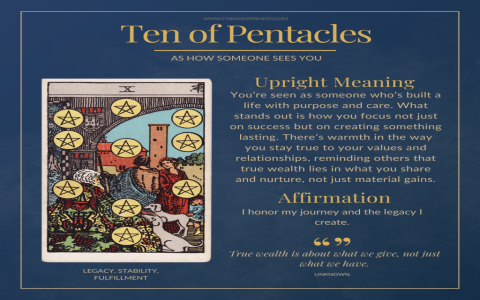
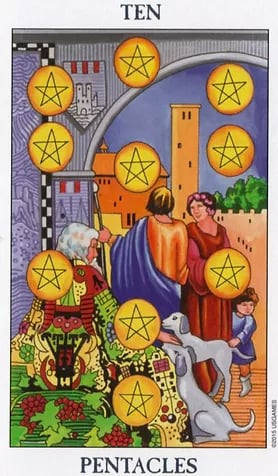
I stared at that image, and for the first time, I didn’t see the gold coins as money. I saw them as weight. Literal, crushing weight. Look closely at the Ten of Pentacles in the Sibyl deck, or really any detailed deck.
- Look at the Structure: It’s not a cheerful modern home. It’s an old, heavy, dark building. It screams permanence, which is supposed to be good, but it also screams trap. You can’t just knock a wall down and redecorate when the foundation is centuries of tradition.
- Look at the People: They aren’t smiling, waving, and celebrating a lottery win. They’re clustered. They look busy, or tired, or resigned. The oldest people are usually very dominant, watching the younger ones with a kind of serious expectation.
- Look at the Dogs: Even the animals look fixed in place. They’re guardians, not playful companions. They’re there to protect the structure, not the people’s happiness.
I looked back at Frank, who was sweating under the kitchen light. I told him: “Frank, this card is not about money. It’s about suffocation. Your son is in a cage. That business is a massive weight, not a warm blanket. It’s a structure built by people who died a long time ago, and now your kid is expected to carry it until he dies.”
The Real Prediction That Hit Home
Frank went silent. He admitted the construction firm was basically running on fumes and legacy. They had stacks of cash, sure, but they were doing things the way his grandfather had done them fifty years ago. The son didn’t hate the work, he hated the obligation and the fact that he wasn’t allowed to change anything because “that’s the way it’s always been.”
My simple, non-textbook reading immediately put the focus on the actual problem: the generational pressure, not the generational profit. I told Frank, “Your son can’t quit and walk away clean. The Ten of Pentacles means the roots are too deep. He’ll be pulled back in, or constantly feel guilty. The only way out is to actively break the pattern, not just quit the job.”
That’s what they did. The son didn’t quit. He stayed, but he forced a restructuring, causing huge family headaches but ultimately modernizing the operation. He only did that because he realized the card wasn’t promising him a reward; it was showing him a life sentence if he didn’t fight back.
So, forget the silly “expert tips” about wealth and stability. When I see this card now, my actual tip, the one that works every time for accurate predictions, is this: What is the heaviest thing in their life? Is the weight of the family name crushing them? Is the stability actually just inertia? If it’s a future prediction, it’s not promising security; it’s warning them about the heavy cost of that security. That’s the only way this card ever tells the real story.