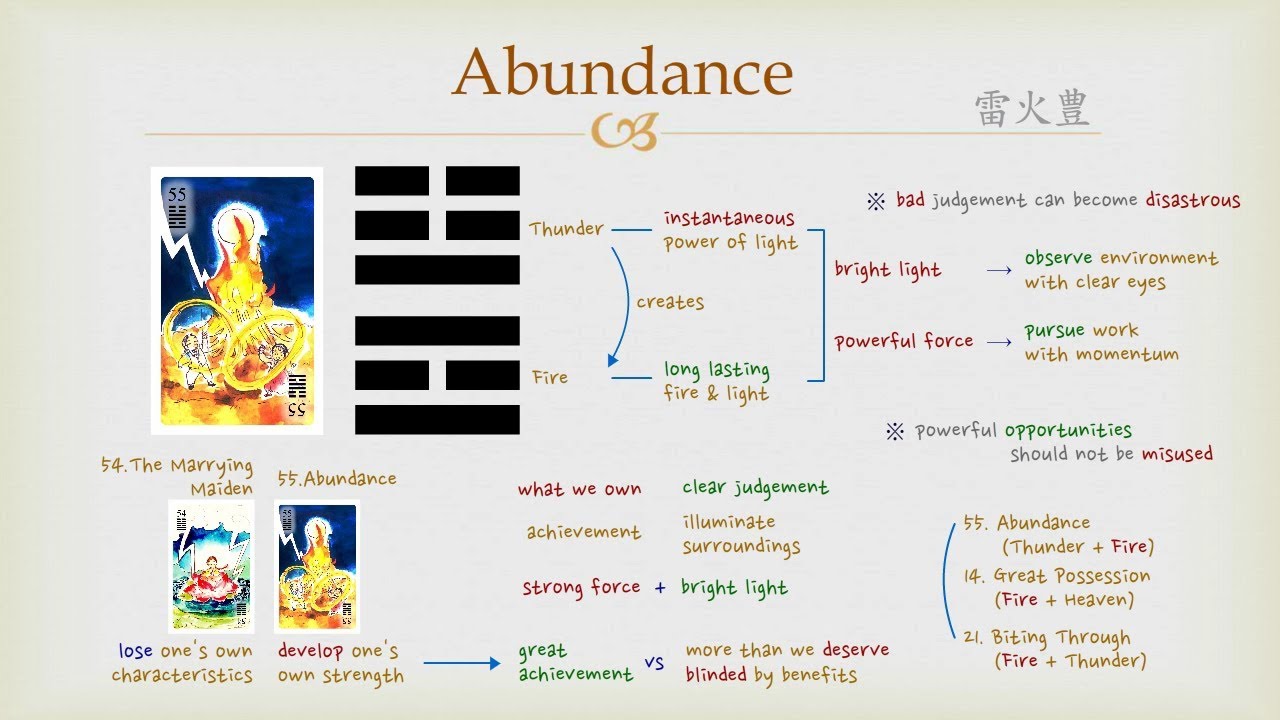
I want to talk about Hexagram 55, Feng, or Abundance. That one is tricky because when everything looks perfect, that’s often when you need guidance the most. You’re at the peak. Where do you go from there?
I ran into this wall a few months back. I had just wrapped up this massive project, the kind where the paychecks were huge and the client was ecstatic. I felt like the King of the Mountain. Totally Feng. I tossed the coins for a quick confirmation on the next move, expecting maybe Hexagram 1 or something else super strong. Nope. I got 55, with multiple changing lines. And suddenly, the sheer weight of interpreting those individual lines—each one warning about the difficulty of maintaining true abundance—hit me like a truck.
I pulled out my three reference texts. You know the drill. Wilhelm/Baynes, some modern translation, and the super-ancient confusing one. I sat there for an hour, trying to blend the interpretations of line 2 moving to line 5, or whatever mess I had spun up. The language was beautiful, sure, but completely useless when I just needed a quick, blunt assessment. I didn’t need poetry; I needed instructions. Was I supposed to act fast or sit tight? Was I overestimating my position or was the danger internal?
The Practice: Boiling Down the Lines
That day, I decided I wasn’t going to look up the meanings anymore. I was going to
create
the simple meaning myself. I grabbed the core concept of Hexagram 55: Maximum visibility, maximum energy, but also maximum potential for things to go wrong because you get arrogant or you stop seeing the details.
I went line by line. I
read
every commentary I owned for Line 55.1. Then I
threw away
all the flowery language. I just
asked
: What is the absolute, simplest action this line is telling me to take or avoid? What is the core fear or benefit?
Line 55.1, the initial line, often talks about meeting your proper partner or friend. It’s an easy start, but the danger is getting too excited too fast. I
condensed
that idea. It means: Are you connecting with the right people, or are you just celebrating alone?
Then I
wrestled
with 55.3. That one talks about thick fog and broken elbows. Yikes. That’s complicated. What is the fundamental lesson? You lose clarity and you lose capability. So I
slapped
a big warning sign on it: Your vision is obscured, stop trying to physically force the issue. That’s it. Stop pushing things you can’t see clearly.
I spent an entire afternoon doing this. I
compared
the ancient Chinese character meanings, I
ignored
the modern psychological takes, and I
zeroed in
on the practical command. If I pull this line, what must I do right now?
The Quick Guide I Built (My Simple Cheat Sheet)
This is what I finally
achieved
—the six essential, rough-and-ready interpretations of Hexagram 55 lines. This guide is for when you are flush with success but need to make a move before the inevitable decline kicks in. You just look up your moving line and get the raw instruction.
- Line 55.1 (The Beginning): Check your network. Prosperity starts small and requires allies. Are you isolating yourself?
- Line 55.2 (The Advance): Maintain authenticity. You have success, but don’t fake anything. Be exactly who you are, or the fullness will be hollow.
- Line 55.3 (The Warning): Retreat and rest. The “fog and broken arm” means you’ve lost both clarity and power. Stop moving forward until the fog clears.
- Line 55.4 (The Pivot): Seek connection, no excuses. If you are successful but alone, your abundance won’t last. Go find the people who can truly support you, even if it feels humiliating to ask.
- Line 55.5 (The Apex): Trust your intuition. Everything looks perfect, and it probably is, but the only danger is internal doubt. Act decisively with good intention.
- Line 55.6 (The Decline): Light is fading. This isn’t a disaster, but the party is definitely winding down. Don’t chase the past glory. Accept the reduction and prepare for the next cycle.
What I Learned Through This Practice
I immediately
tested
this new cheat sheet a week later. I was getting ready to hire someone important, and the coins showed 55.3 moving to 37 (The Family/Clan). My quick guide said: “Retreat and rest. Stop trying to physically force the issue.” My immediate reaction had been to rush the hire because of project deadlines.
Because I
obeyed
the simplified instruction, I hit pause. I didn’t push the deadline onto the candidate. I
slowed down
the interview process. Guess what? Two days later, a much better, more experienced candidate walked into my orbit entirely by chance. If I had followed my initial panicked instinct, I would have hired the wrong person and the whole project would have suffered. The “broken arm” meant my own ability to judge under pressure was compromised.
This simple process—this practice of
tearing apart
the complex language and
building back
the raw instruction—made the I Ching immediately useful again. If you’re a beginner, don’t let the scholarly translations scare you off. Grab a hexagram you see often, find the best translations you can, and then completely
ignore
them. Just
ask
: If this is a direct command, what is it telling me to do right now? You’ll find that the ancient wisdom finally starts talking to you in a way you can actually use when life is messy.