Man, sometimes life just throws you for a loop, right? You hit a wall, you feel stuck, and you’re just scrambling for some kind of sign, any sign, to tell you what the heck to do next. That’s exactly where I found myself a while back. I was neck-deep in this personal coding project, something I’d poured hours and hours into, months even. I had this vision, this grand idea, but the progress felt like crawling through mud. Every day was a grind, and the finish line was nowhere in sight. I was seriously thinking about just ditching the whole thing, cutting my losses, and moving on. The motivation was just… gone.
I’ve always been one to look for answers in unusual places when the usual ones don’t cut it. My dad, bless his soul, he always had this old, beat-up copy of the I Ching lying around. Never really understood what he was doing with it, just saw him flipping pages and muttering to himself sometimes. But when I was feeling this low, this completely drained, I remembered that book. It felt like a long shot, a crazy idea, but hey, what did I have to lose?
So, I pulled that dusty thing off the shelf. Found some coins – three old pennies, not fancy at all – and just sat down at my kitchen table one evening. I didn’t know the exact ritual or anything, just kinda winged it, you know? I held the coins, closed my eyes, and just poured all my frustration, all my confusion, into that moment. I asked the universe, or whatever was listening, for some guidance on this project, on whether I should keep pushing or just give up. I shook those coins in my hands, tossed them six times, marking down the lines as they came up, one after another.
After the sixth toss, I had my hexagram. I traced it out on a piece of scrap paper. Then I went to the book, fumbled through the index, trying to find the right number. And there it was: Hexagram 32. The name itself was a bit intimidating at first: “Heng.” The book called it “Duration,” “Constancy,” “Perseverance.”
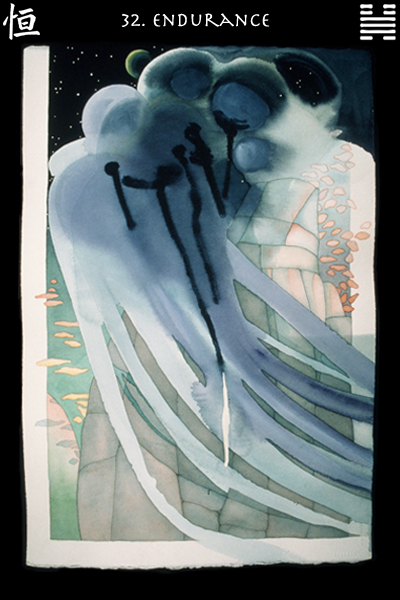
The Initial Head Scratching
My first thought? “Duration? Constancy? What the heck does that even mean for my project?” I was looking for a clear “yes” or “no,” a “keep going” or “stop now.” This felt vague. I read through the commentary, the bits about the image, the judgment, and the individual lines. It talked about things like “steadfastness,” “lasting through time,” and “no blame if you are constant.” It even mentioned a warning about “not seeking change too hastily.”
Honestly, it felt a bit like a cosmic shoulder shrug at first. I sat there for a good long while, just staring at the page, then at my half-finished code on the laptop screen. My brain was still screaming, “But should I keep going or not?” The answer seemed to be, “If you do keep going, be constant about it.” Which, well, wasn’t exactly the quick fix I was hoping for.
The Slow Burn of Understanding
But something about it gnawed at me. The idea of “duration.” Not just “doing it,” but “doing it for a long time.” I kept thinking back to why I started the project. It wasn’t for a quick buck or instant fame. It was because I genuinely believed in the idea, in what it could become. It was a long-term vision. And that’s when it started to click.
The I Ching wasn’t telling me whether my project was good or bad, or if it would succeed or fail in the traditional sense. It was addressing my attitude towards it. My problem wasn’t the project itself; it was my wavering commitment, my impatience for results. Hexagram 32 was a mirror, reflecting my own lack of enduring spirit back at me.
- It wasn’t about the outcome; it was about the journey, and my commitment to it.
- It wasn’t about speed; it was about steady, consistent effort.
- It wasn’t about giving up when things got tough, but about finding the inner strength to just keep showing up.
I realized I had let myself get distracted by the lack of external validation or immediate payoff. I had forgotten the intrinsic value of simply doing the work, of building something piece by piece, day after day. The “wisdom” wasn’t a magic spell; it was a reminder of something I already knew deep down but had forgotten in my frustration.
Putting “Constancy” Into Action
So, what did I do? I didn’t suddenly get a burst of superhuman energy. Instead, I changed my approach. I broke down my big, daunting project into tiny, manageable chunks. Instead of trying to code for hours and burning myself out, I committed to just 30 minutes every single day, no matter what. Some days, it was a painful 30 minutes, but I showed up. Other days, those 30 minutes would turn into an hour or two because I got into a flow. The key was the consistency, the “duration.”
I stopped checking metrics or expecting breakthroughs every week. I just focused on the small, incremental progress. I started appreciating the act of learning, of solving one tiny bug, of writing one more line of clean code. It became less about the destination and more about the daily act of putting one foot in front of the other.
The Unseen Results
And you know what? Slowly, almost imperceptibly, things started to shift. The mud started to feel a little less sticky. The small wins added up. The project didn’t suddenly explode in popularity or make me rich, but it got done. I finished it. And the sense of accomplishment, that feeling of having seen something through, from idea to completion, because I stuck with it, was something else entirely. It wasn’t about the I Ching giving me an answer; it was about it pushing me to find the answer within myself, to recommit to what I truly valued.
That old book, those random coin tosses, they didn’t solve my problem directly. But they gave me a framework, a lens through which to view my struggle. They nudged me towards understanding that some things in life, the truly worthwhile ones, just demand consistent, patient, enduring effort. And that, in itself, is the real reward.