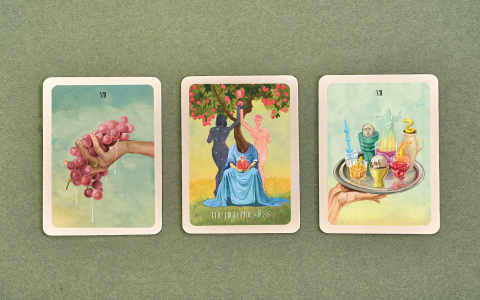
Alright, so you’ve decided to dip your toes into the world of intuition cards. That’s awesome! It can feel a little overwhelming when you start browsing, though. I remember standing in the bookstore aisle, staring at dozens of decks, feeling like I needed a deck to tell me which deck to buy!
My first experience was a total mess. I bought a deck because the artwork looked cool—big mistake. The booklet was dense, the card meanings were super abstract, and I just couldn’t connect with it. It sat on my shelf collecting dust for almost a year until I finally figured out what I was doing wrong.
My First Go-Around: Learning the Hard Way
I dove straight in with something called a “Cosmic Archetype Deck.” Sounded fancy, right? The illustrations were these super detailed, almost surreal paintings. I thought, “The deeper the art, the deeper the insights!”
Step 1: The Attraction Phase (Looking only at the pictures). I picked it up purely based on aesthetic. I loved the deep purples and golds. It felt important.
Step 2: The Confusion Phase (Trying to read the guide book). I brought it home, eagerly shuffled, and pulled my first card: “The Weaver of Forgotten Truths.” I flipped to the guidebook. The description was three paragraphs of very esoteric language talking about universal constants and the shadow self. I read it three times and honestly had zero clue what it meant for my day-to-day life, which, at the time, involved trying to find my lost car keys.
Step 3: The Shelving Phase (Giving up). If I couldn’t understand it after 20 minutes, I assumed I wasn’t intuitive enough. It went into the closet.
The Pivot: Finding What ACTUALLY Works for Beginners
A few months later, a friend who had been reading cards for years sat me down and said, “Forget the heavy stuff. You need training wheels.” She told me to focus on two things: clear imagery and actionable text.
I started my search again, but this time, I ignored the super serious, heavily themed decks.
What I Looked For In My Successful Second Attempt:
- Simple Keywords on the Card: I wanted a deck where the main message was printed right on the card—something like “Release,” “Joy,” or “Boundary.” This acts as an immediate anchor.
- Visual Clarity: The art had to be straightforward. If it looked like a literal picture (a person smiling, a house, a mountain), that was better than abstract swirls or complex mythological creatures. I needed to see a concept, not interpret a painting.
- Guidebook Language: Before buying, I started opening the plastic wrapper just enough to sneak a peek at the language in the guidebook. If it used simple, encouraging language (e.g., “Time to rest and recharge,” or “Ask for help now”), I grabbed it. If it started talking about “Atlantean energies,” I put it back.
I finally settled on a deck that was marketed as “Daily Guidance Cards.” The images were soft, watercolor scenes, and every card had a clear title and a short sentence of affirmation.
The Breakthrough: Connecting the Dots
Once I had the right deck, the whole process clicked almost immediately. Here’s how I started using them:
1. Shuffling and Asking Simple Questions: Instead of asking about my destiny, I started small: “What energy should I focus on today?” or “What do I need to let go of right now?”
2. Immediate Reaction: I pulled a card that said “FLOW.” The image was simple: a river moving around some rocks. My immediate, gut reaction was, “Oh, stop forcing things.”
3. Using the Prompt, Not the Bible: Instead of deep-diving into the book, I would read the card’s title (FLOW) and the small affirmation (“Trust the process, allow things to unfold naturally”). That was it. I used those words as a starting point for my own internal reflection.
This process felt accessible. It wasn’t about memorizing ancient meanings; it was about using a tool to jumpstart my own internal voice. The simplified deck acted like a mirror, not a foreign textbook.
So if you are shopping right now, my advice is this: Go for friendly, positive, and direct communication. Don’t worry about being “deep” yet. Get a deck that helps you find your car keys first; the “Weaver of Forgotten Truths” can wait until you’ve mastered the basics.