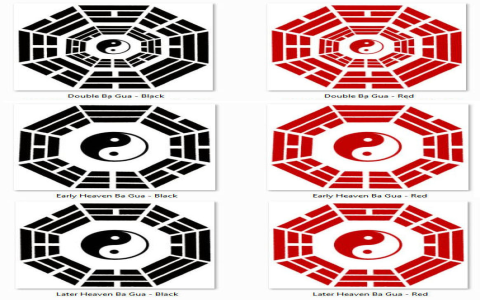
Man, so back when I first got into this whole hexagram thing, it felt like wading through mud. Seriously. Everyone was talking about the I Ching, and I heard all these profound things, but every time I tried to actually do a reading, I’d just get tangled up. It wasn’t about being deep or philosophical for me, I just wanted to get some straightforward answers, you know? Like, what’s up with this situation? What should I do next? Simple stuff. But oh boy, it was anything but simple at first.
I dove into books, and my head just spun. All those interpretations, the different lines, the changing lines, the nuclear trigrams… it was a freaking maze. I’d cast my coins, get a hexagram, and then just stare at it blankly. It felt like everyone else had some secret decoder ring, and I was just holding up a piece of scribbled paper. I was frustrated, honestly. I almost gave up a bunch of times, thinking, “This ain’t for me, too much brain work.”
My Personal Breakthrough
Then one day, I just kinda thought, “Screw this. There has to be an easier way.” I figured, if these things have been around for thousands of years, there must be some fundamental, common-sense stuff going on, right? Not just super deep philosophy. So, I started hacking at it. I basically tried to find the absolute minimum, the core bits that actually gave me something useful.
I stopped trying to memorize everything. Instead, I started breaking down any hexagram I got into seven really simple, actionable points. This wasn’t some official method, just something I cooked up myself to make sense of the chaos. It became my “7-point quick read,” and let me tell you, it changed everything for me. Instead of feeling overwhelmed, I finally started to get it, fast.
My “7-Point Quick Read” Method
Here’s how I started doing it, step-by-step, to cut through all the noise and just get to the good stuff:
- First up, the Overall Vibe: I’d look at the hexagram, like a quick glance. Does it look heavy? Light? Moving? Stuck? Just a gut feeling about its general energy. Is it strong and confident, or kinda shaky and confused? This gave me the immediate emotional tone.
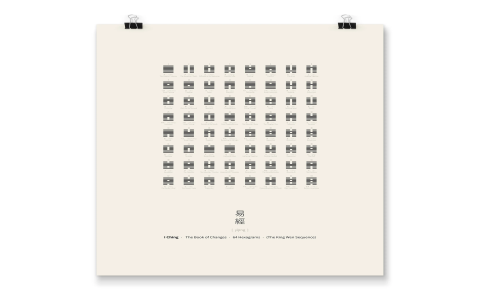
- Then, the Outside Story – Upper and Lower Trigrams: I’d split it into the top three lines and the bottom three. What were these two parts saying independently? One represents the outer situation, the other the inner state. Just basic stuff like “heaven over earth” or “water over fire.” What’s the obvious interplay here?
- Next, The Inside Scoop – Nuclear Trigrams: This might sound fancy, but it’s just the middle four lines, divided into two trigrams. I started seeing these as the “hidden” or “developing” aspects. What’s going on underneath the surface that maybe isn’t so obvious at first glance? It’s like the subtext of the situation.
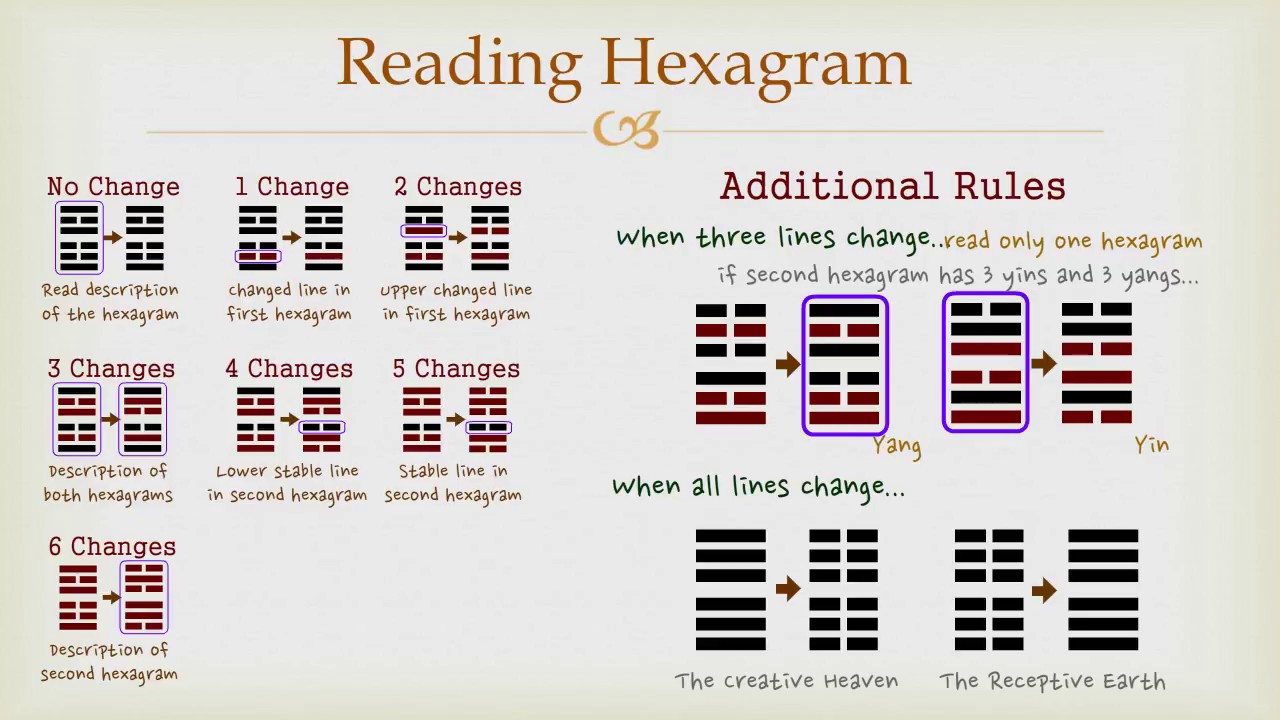
- Spot the Movers – Changing Lines: This one was crucial. If there were any changing lines, those were usually the most active parts. What specific line was yelling at me? I’d zero in on that line’s meaning and see how it related to the overall question. This is where the action usually was.
- Where’s it Going? – The Resulting Hexagram: If I had changing lines, they’d turn into a new hexagram. I’d quickly look at this new shape. The initial hexagram was “where you are,” and the new one was “where you’re headed.” Seeing both side-by-side made the direction crystal clear, like before and after.
- Pick a Keyword, Any Keyword: After all that, I’d try to sum up the entire thing in just one powerful word or a very short phrase. Like “progress,” “stuck,” “caution,” “harmony,” “transformation.” This was my mental shorthand for the whole reading, something easy to remember.
- Finally, The Gut Check: Once I had all that, I’d just close my eyes for a second and feel it. Does it resonate? Does it make sense with what I already kinda felt? This wasn’t about getting a different answer, but confirming and integrating the insights. If it felt right, I knew I was on the right track.
Doing it this way, breaking it down into these seven quick steps, it stopped being this giant, uncrackable code. It became a practical checklist. I didn’t need to be a scholar; I just needed to follow my own little routine. It made reading any hexagram, whether I was looking at one or a sequence, so much faster and way less intimidating. I actually started getting useful stuff out of it, and that’s when it really clicked for me.