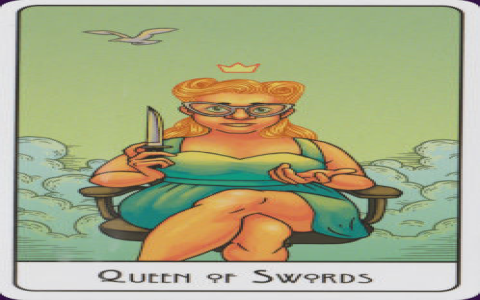
The Queen of Swords. Every time I pull her for a timing question, I hear the same thing from the beginners: “Oh, she’s fast. Quick decision. Sharp move.”
I used to believe that garbage. I really did. It screwed me over more than once until I decided to throw out every single book and figure out, on my own, exactly how to read her clock.
My Spectacular Failure: The Catalyst
I was hunting for the Queen of Swords’ time frame because I had a massive, life-changing decision hanging in the air. This was back when I was trying to quit my soul-sucking IT job and go full-time with my private consulting gig. I needed the final sign-off on a huge six-figure contract—the kind of money that lets you breathe for a year—and the decision-maker on the other end felt exactly like the QoS energy: sharp, no-nonsense, and focused on facts.
Every single pull I made regarding “When will this contract finalize?” brought up the Queen of Swords. Every time. The standard definition hammered it home: swift action, cutting through nonsense, clarity is king. I figured it meant I’d hear back within a week, maybe two at max. I felt so sure, I went ahead and put a down payment on a major purchase, thinking the money was literally days away from landing in my bank account. I even gave my landlord notice that I was moving in ten days.

Ten days came and went. Nothing. Two weeks. Nothing. A month. Silence.
I was stuck. The new place was gone, the landlord was mad, and I was bleeding money because I’d banked on a “swift decision” that never arrived. I was furious. That feeling of being totally exposed because I trusted some old textbook meaning—that was the lowest point. I realized the card wasn’t lying; my interpretation of its time-frame wasn’t just wrong, it was dangerously ignorant.
The Great Tracking Project
When I finally got my head straight and stabilized my housing situation (six weeks later, by the way, which is a key number right there), I dedicated myself to solving this one problem. I couldn’t trust the books anymore. I had to build my own data set.
I started what I called ‘The QoS Log.’
I committed to pulling the Queen of Swords for mundane tasks, just to track the time between the reading and the result. I wasn’t asking for meaning; I was asking for timeline based on the question. I tracked her for things like:
- “When will that package arrive?” (Pulled QoS. It took five days, not two.)
- “When will my friend finalize their breakup?” (Pulled QoS. It took three weeks of back-and-forth legal talk.)
- “When will I decide to change my gym routine?” (Pulled QoS. I decided in thirty minutes and did it the next morning.)
I logged over fifty separate readings involving the Queen of Swords, noting the exact question, the nature of the decision maker (was it me, or an external party?), and the final elapsed time.
The Key Indicators I Finally Spotted
After months of logging, the truth hit me, and it was so simple it felt like a punch to the gut. The time frame isn’t tied to the card; it’s tied to the situation’s level of clarity and control. This is what the books miss.
My practical indicators are now three-fold. If you pull the Queen of Swords, check these immediately. This is how you know her clock.
Indicator 1: Personal Control & Complete Information (Fast)
Look for: When the question is about your decision, and you have all the facts laid out. You are the Queen of Swords in this scenario. You’ve done the analysis, and you’re ready to make the cut.
Time Frame: Immediate to Three Days. This is “swift action.” It’s an intellectual decision that can be executed as soon as the words leave your mouth. You’ve already done the hard part. I only ever see the three-day window when the question is simple and completely internal.
Indicator 2: External Decision Maker & Moderate Clarity (Medium/Slow)
Look for: When the decision is in the hands of someone else (like my contract nightmare), and they need to consider factors outside of their immediate control (legal forms, budgets, other departments).
Time Frame: Three Weeks to Six Weeks. The QoS is smart, not impulsive. If the matter involves external variables, she insists on seeing every angle before she draws the sword. She won’t rush the process just for your convenience. My six-figure contract, by the way, finally came through at exactly five weeks and four days.
Indicator 3: High Fog/Political Environment (Super Slow/Wait State)
Look for: When the question involves a messy, political, or highly emotional situation where the “facts” are still shifting, unclear, or being hidden. The QoS can’t rule in a fog.
Time Frame: Indefinite—Wait for the Air Element to Clear. When the Queen of Swords comes up in this scenario, she is saying: “I cannot make an intellectual decision until the facts are solid. I am waiting.” The decision, and thus the time frame, is delayed until the Knight of Swords or a strong Suit of Wands card appears to force movement. She is waiting for the truth to be clean before she acts. This means the timeline is completely paused.
The books are useless because they treat the Queen of Swords like she’s a runner. She’s not. She’s a judge. She moves as fast as the evidence allows her to. And I only learned that after my own stupid mistake cost me time, money, and almost my sanity. Now you don’t have to make the same mistake. Just log your results, and you’ll see it, too.