You know, some folks look at these old systems, like the I Ching, and think it’s all mumbo jumbo, or just abstract ideas. But let me tell you, when you actually roll up your sleeves and dig into one of these hexagrams, especially one like number 40, “Liberation,” that’s when it gets real. It’s not just a fancy word; it’s a whole process, a journey you go on when life throws you a curveball.
I remember this one time, oh man, I was really stuck. It wasn’t just a little problem, it felt like I was wading through quicksand. Every single thing I tried, whether it was trying to fix a relationship thing that had gone sour, or trying to push a work project that just wasn’t moving, it just kept getting heavier. I was literally spinning my wheels, pouring effort into something that felt like a black hole. Days turned into weeks, and I just kept feeling more and more frustrated, trapped, you know? Like I was in a cage, but all the bars were invisible.
I was really at my wit’s end. My old man, he always had this dusty old copy of the I Ching sitting on his bookshelf. I’d seen it a million times, never really paid it much mind beyond thinking it was just another weird old book. But that particular week, feeling so bogged down, I don’t know, something just clicked. I just grabbed it, blew off the dust, and just thought, “What’s the harm? Maybe there’s something in here.” I wasn’t looking for magic, just a different way to look at my mess.
So I went through the whole process, doing the coin tosses, watching them fall onto the table, feeling a bit silly, to be honest. But I followed the steps, tallied them up, and there it was: Hexagram 40. “Liberation.” My first thought? “Oh, great. Easy for you to say.” It felt almost mocking, hearing “Liberation” when I felt anything but liberated. I remember just staring at the page, reading the judgment, the image – Thunder and Rain – and thinking, what the hell does a thunderstorm have to do with my stagnant life?
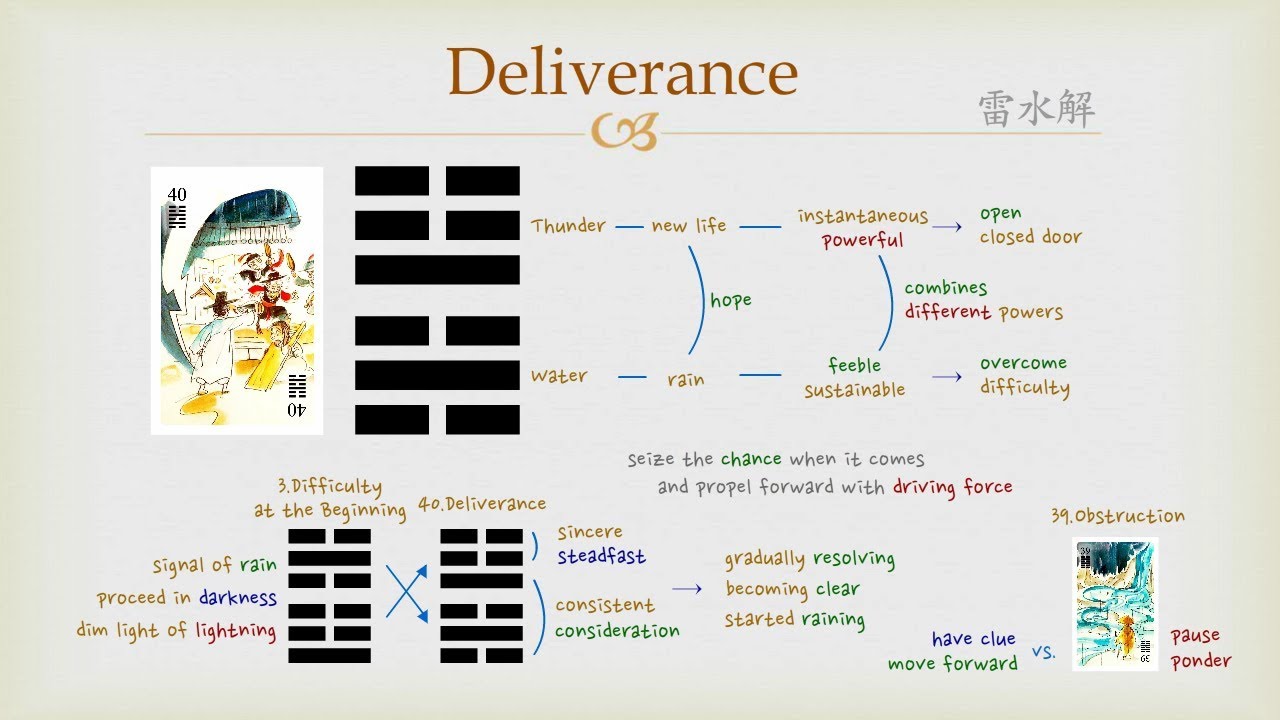
But the thing is, I didn’t just close the book. Something made me actually sit with it. I opened it again and started to really chew on those words. The main message talked about untying knots, about overcoming obstacles. It wasn’t saying, “Poof, your problems are gone!” It was talking about a process. And that’s where the real journey began for me.
My Dive into Understanding Hexagram 40
I started by simply trying to visualize the image: Thunder and Rain. I thought about a massive storm, how it builds up, how intense it gets, and then how it breaks. And after that, the air is fresh, everything feels washed clean, and there’s a sense of release. It’s not about the storm not happening; it’s about the release after it. That was a first little spark.
Then I went through each of the six lines of the hexagram. This was the part that really got me. I didn’t just read them; I tried to connect them to my own life, to that specific situation where I felt trapped:
- The first line talked about being without blame, about going forth and returning. I started thinking, was I blaming myself too much? Was the first step to freedom actually forgiving myself, or realizing I wasn’t the sole cause of the mess? It made me consider that sometimes, simply acknowledging your situation without piling on guilt is the first untying.
- Another line spoke about catching a great animal, but not releasing it, and then catching a small animal and releasing it. This one really hit me. It made me realize I was probably holding onto something too big, something that wasn’t mine to control or change directly. Maybe I was clinging to a specific outcome for that relationship or that work project. It forced me to ask myself: what am I trying to force? What can I actually release?
- Then there was the line about untying your great toe. Sounds kinda funny, right? But it made me think about tiny little things that keep you tethered. Small habits, small grudges, small expectations. Sometimes, it’s not the big chains, but all these tiny strings holding you back. I started looking at the small stubborn ways I was clinging to the past or to a specific idea.
- The lines also mentioned letting your companions go, and then later getting help from others. This was a game-changer. I realized I was trying to shoulder everything alone. “Liberation” didn’t mean solitary escape; it meant knowing when to let go of burdens that aren’t yours, and knowing when to ask for help, or to let others do their part. It was about releasing control.
It sounds simple, just reading lines. But I didn’t just read. I reflected. I’d walk around, do chores, and these lines would just pop into my head. I’d try to find examples in my own past where I felt stuck and then found a way out. What did I do then? What did I let go of? Slowly, the fog started to lift. It wasn’t instant understanding, it was like piecing together a puzzle, one little insight at a time.
My “Aha!” Moment and The Practice
The real shift came with that work project. I was determined to push my solution, even though everyone else felt it wasn’t right. I was clenching, resisting any other ideas. But after really sitting with Hexagram 40, especially that part about catching the big animal and letting it go, it hit me: I was the one holding the project hostage with my stubbornness. I wasn’t liberating the project; I was stifling it.
So, I actually did it. I called a meeting, and instead of defending my idea, I just laid out the problem. I said, “Look, I’ve been trying to force this, and it’s not working. What are your thoughts? What should we release to move forward?” It was scary, admitting I might have been wrong, letting go of that control. But man, the room just lightened up. People started throwing out ideas I hadn’t even considered. We started pulling apart the project, not to destroy it, but to untie the knots that I had actually made worse by holding on too tight. We let go of some timelines, some features, some old expectations.
The project didn’t instantly succeed with a fanfare, but the energy around it changed completely. The team felt liberated to contribute. I felt liberated from the burden of trying to control everything. It wasn’t the project itself that was liberated; it was our approach to it, and my own internal struggle. The actual outcome was a lot smoother, things started moving, and we eventually got it done, in a way that was far better than my initial stubborn vision.
From that point on, whenever I feel that familiar squeeze of being trapped, whether in a conversation, a dilemma, or a big life decision, I always go back to that idea of Hexagram 40. It’s not about waiting for external circumstances to change, but about finding what internal knots I can untie. What preconceptions can I release? What blame can I shed? What unnecessary burden am I carrying? It’s about recognizing that sometimes, the greatest act of progress is simply letting go.
It turns out, those dusty old books sometimes hold more practical wisdom than all the fancy self-help gurus combined, you just gotta be willing to roll up your sleeves and really live with the words.